
Unskinned
On belonging, survival, and the long search for home

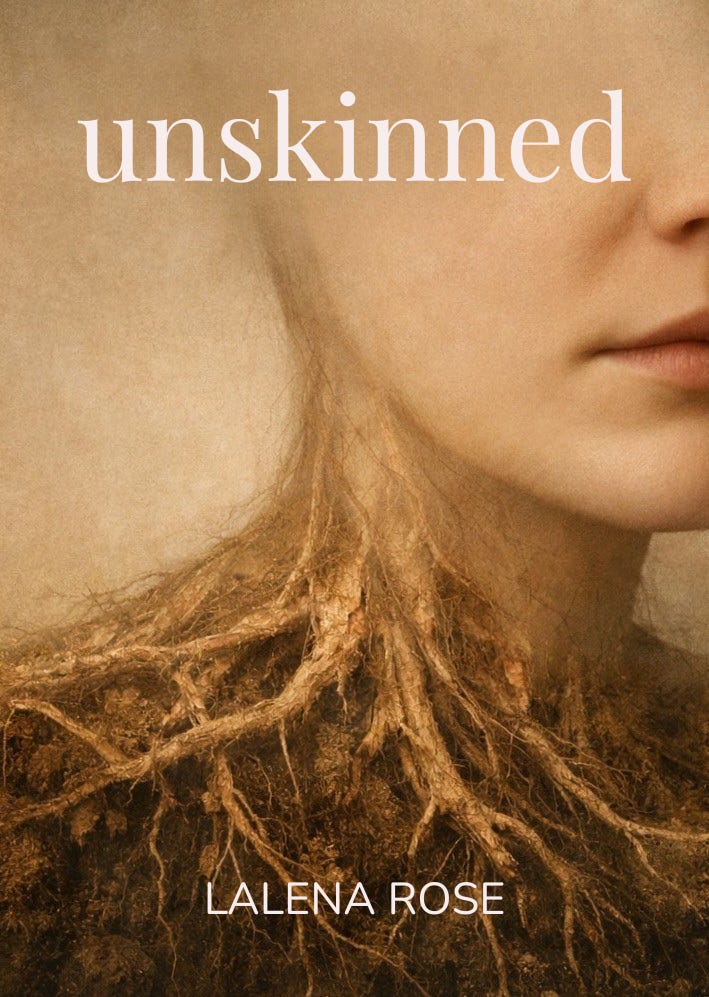
For as long as I can remember, people have told me I should write a book. Sometimes after hearing fragments of my life. Sometimes after long conversations that somehow drifted into places most people do not usually speak about openly. Sometimes after witnessing the sheer improbability of certain chapters and asking, with a kind of stunned expression, how one person could possibly have lived through so many different lives within a single lifetime. And for years, I considered it. There were periods where I carried a notebook everywhere. Years where I mentally structured chapters while driving, walking, hanging washing out, cooking dinner, or scraping weetabix off walls while simultaneously contemplating the deeper meaning of existence. I thought about timelines, beginnings, endings, and which stories mattered most. I wondered whether it would be memoir, reflection, poetry, or some strange hybrid of all three. But every time I approached it seriously, something felt off. I could never quite find the doorway in.
At the time, I thought the problem was technical. I thought I simply had not yet found the right structure or perspective. Perhaps I needed more distance. Or was it clarity, or more understanding? I thought writing a memoir required arriving somewhere first. Some stable place where everything finally made sense and could be neatly gathered into language. Unfortunately life does not appear particularly interested in neatness! Eventually I realised the issue was never the writing. It was what the writing required me to stay present with. Because beneath all the experiences, beneath the extraordinary events people always told me should become a book, there was another story running quietly underneath the entire thing. And that story was belonging. Or perhaps more truthfully, the absence of it. I can see now how much of my life was shaped by this. The choices I made. The relationships I entered. The identities I wrapped around myself. The ways I adapted in order to remain connected to others.
I think many of us are living far more from this place than we realise. What happens to a person when they do not fully feel they belong to themselves, their body, their family, the wider world, or even life itself? What happens when belonging becomes something we spend our lives trying to secure rather than something we experience internally? We begin organising ourselves around the absence. We overadapt. Overgive. Oversurvive. We become extraordinarily skilled at reading rooms, anticipating needs, shape-shifting into versions of ourselves that feel more acceptable, more loveable, more needed. We become deeply competent while feeling increasingly far from ourselves. And because these adaptations often begin early, they stop feeling like adaptations at all. They simply become personality. Life.
For years I consciously worked on these patterns through every modality and therapeutic space I could find. I explored attachment theory, trauma work, somatic therapies, embodiment practices, breathwork, spirituality, psychology, nervous system work, relationship dynamics, healing spaces, personal development, all of it. And many of these approaches helped me enormously. They gave language to experiences I had never previously understood. They helped me recognise patterns that had shaped my life for decades. They opened doors that mattered deeply. But somewhere along the way I also began noticing that despite all the insight, despite all the work, despite genuinely profound shifts in awareness, something in me was still searching. Still restless. Still subtly trying to arrive somewhere else. I can see now how much of my life was shaped by the hope that somewhere, eventually, I would finally find the place where I could fully exhale into myself.
At one point I came across the phrase “doing a geographical,” a term sometimes used in recovery spaces to describe moving across the world believing something will finally be better somewhere else, only to discover that wherever you go, there you are. I laughed when I first heard it because it landed slightly too accurately. And honestly, I think my move to South Africa was, in many ways, my final geographical. Not consciously. I genuinely loved so much about being there. The beauty, the wildness, the scale of the landscape, the feeling of aliveness that moved through the land. But underneath it there was also still that familiar longing. The hope that perhaps this would finally be the place where everything settled internally. The place where I would finally feel fully at home inside myself. Instead, what happened was something far more confronting and ultimately far more meaningful. I reached the end of the search.
I realised that I had spent years trying to find externally what could only ever be cultivated internally through relationship with myself, with my body, with life, and with the earth beneath my feet. This surprised me! Somewhere over the past few years, amongst the greenhouse obsession, the river walks, the endless slightly feral conversations with plants, the cold air on skin, the soil under fingernails, and the increasing inability to care about things that once consumed enormous amounts of my energy, my life began reorganising itself. The body softens in living relationship with life. There is a kind of regeneration that emerges through birdsong, seasonality, growing things, weather, rhythm, and contact with environments that are alive rather than purely constructed around human nervous system overwhelm.
But what began reshaping me most deeply was not simply the soothing effect of nature. It was the profound shift in understanding that came through the eco somatic lens. The recognition that ecology is not something happening around us. It is what we are. The body is not separate from the living world observing it from a distance. It is the product of approximately 4.5 billion years of evolutionary relationship with life itself. Every layer of the nervous system has been shaped through relationship with earth, water, weather, gravity, rhythm, sunlight, other bodies, other species, and the wider ecology we emerged from.
Something inside me settled differently when I began understanding belonging through that lens. For so much of my life I had unconsciously organised belonging around human structures alone. Family systems. Relationships. Places. Community. Identity. And while all of those things are important, something expanded in me when I began experiencing myself as part of a far older lineage than I had previously understood. The earth herself began feeling less like a backdrop to my life and more like an actual living relationship I belonged within. The sun. The soil. The rivers. The ecological ancestors that made human life itself possible. The primordial parents of earth and sun. There was something profoundly regulating in recognising that my body belongs to an evolutionary story far older than my personal history. That beneath all the fractured attachment, adaptation, and longing, there is also this deeper belonging that has never actually been broken.
And slowly, all the tools, insights, therapies, and understandings I had gathered over the years began landing somewhere deeper. Less conceptual. Less performative. More lived. I stopped trying quite so hard to become healed and started becoming more present. Because I finally had enough steadiness internally to remain present with my own story without immediately trying to escape it, redeem it, intellectualise it, or transform it into something neat and inspirational. I could simply see it, feel it, and tell the truth about it.
And I think that was the doorway I had been waiting to emerge for all those years. Not the perfect structure. Not the perfect opening sentence. Not some polished literary identity where I transformed into the kind of woman who effortlessly writes profound memoirs while wearing linen and staring thoughtfully at trees. Although admittedly I have spent quite a lot of time staring thoughtfully at trees recently. The doorway was groundedness. The ability to remain present inside my own life long enough to witness it honestly. Without turning away. Without performing. Without needing to become someone else in order to tell the truth.
I think this is why the title Unskinned arrived with such certainty once it finally came. Because writing the book has felt exactly like that. The gradual removal of the layers I once needed in order to survive. The performances. The identities. The coping structures. The explanations. The versions of myself built around adaptation and endurance. And underneath all of it, what I found was not some final perfected version of myself waiting patiently to emerge. I found tenderness. I found grief. I found longing. I found the deep human desire to belong. I found younger parts of myself who had spent years searching for home in places that could never fully provide it. And increasingly, I found compassion for the woman who made the choices she made while trying to survive the only way she knew how.
I think many women arrive at this threshold in midlife. A point where the old adaptations begin collapsing under their own weight. A point where continuing to abandon ourselves becomes more painful than finally telling the truth. A point where something deeper begins asking to be lived. Sometimes this arrives as exhaustion. Sometimes grief. Sometimes rage. Sometimes the sudden urge to grow vegetables and disappear into the woods while reconsidering every life decision you have ever made. And sometimes it arrives as a book that quietly waits decades for you to become ready enough to write it.
There is a line I wrote recently that has stayed with me ever since. A story of losing ground, and learning how to live without leaving. And in many ways, that is what Unskinned became. It became a story about what shapes us, what fractures us, and what eventually calls us back to ourselves. A story woven through the body, through motherhood, through love, survival, adaptation, and the lifelong search for home.
Unskinned will be released on the 13th October this year.
Saying that aloud still feels slightly surreal after all these years of carrying it. Some of you have heard fragments of this story over time. Some of you are only just arriving here. Either way, I’m deeply glad you’re here for this part of it. I’ll be sharing more as the release approaches, including early excerpts, reflections from the writing process, and early access for those who would like to follow the journey more closely.
I would love to hear your reflections on this, particularly the ways belonging — or the search for it — has shaped your own life and choices over the years.